Introduction
Choosing a private label jewelry manufacturer is not a matter of finding the lowest unit price in a catalog. It is a supplier-selection decision that affects what you can claim about a product, how accurately a sample can be repeated, whether packaging arrives ready for retail, and how much risk sits between a confirmed order and a launch date.
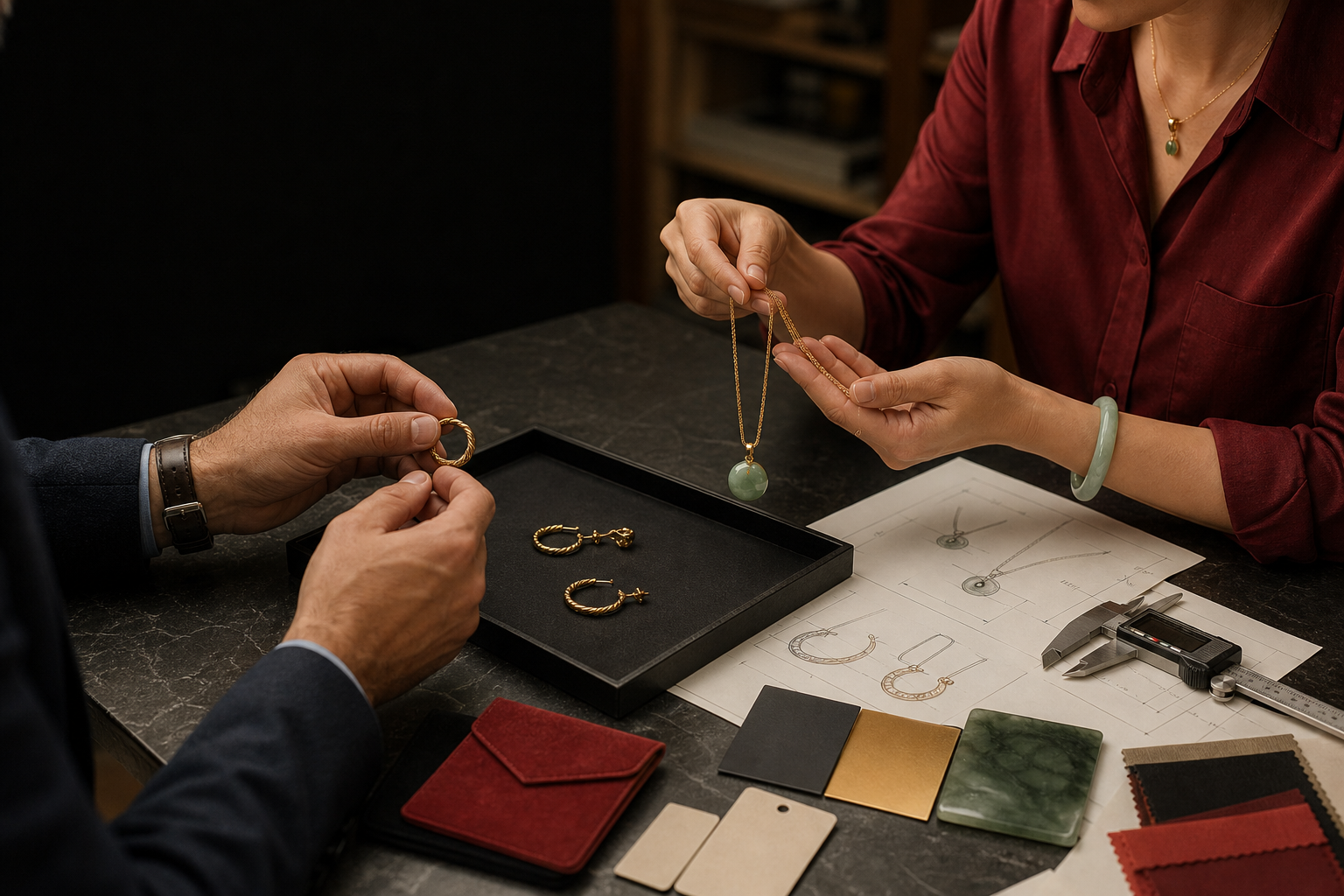
For a brand, retailer, or distributor, the most useful question is: can this supplier repeatedly make the approved product for our market, channel, and quality standard? A credible answer requires more than product images. It needs a clear materials brief, a sampling route, written acceptance criteria, realistic order minimums, and a documented handover process.
This checklist is designed for buyers sourcing fashion jewelry, natural-stone pieces, pearl jewelry, plated designs, and private-label collections. It is also useful when comparing an established factory with a trading company, or when evaluating a supplier before an initial 100-piece order.
The short answer: what should a buyer compare?
Compare a jewelry manufacturer on eight points: product and material capability, specification control, MOQ logic, sample process, quality control, compliance evidence, packaging readiness, and communication during exceptions. Price matters, but it is a result of these inputs. If the inputs are unclear, a low quote rarely remains low after revisions, rejects, expedited freight, or customer returns.
1. Start with a commercial brief, not a product screenshot
A supplier can only quote accurately when the brief says what the buyer intends to sell. A screenshot is useful visual direction, but it does not define a product. Before contacting suppliers, write a one-page brief that answers the following questions:
- Who is the end customer and where will the item be sold?
- Is the piece trend-led, giftable, occasionwear, or intended for frequent wear?
- What is the target retail price and target landed-cost range?
- Which materials are mandatory, optional, or prohibited?
- What are the required color, finish, length, stone, pearl, logo, and packaging choices?
- Is the design an existing catalog adaptation or a new development?
- What documentation is required for the destination market or customer account?
This preparation prevents a common sourcing failure: comparing quotations that are not for the same product. One supplier may quote brass with a light finish, another may assume stainless steel, and a third may include a branded box. Those prices cannot be meaningfully compared until the inputs are aligned.
Build a product specification sheet before sampling
The specification sheet is the operational version of the brief. It should include a product image or drawing, a revision number, material callouts, dimensions with tolerances where critical, finish color, clasp or finding type, stone or pearl grading criteria where relevant, logo location, packaging components, and the approved sample reference once it exists.
For example, “gold necklace” is not a sufficient description. A controlled specification may state: “925 sterling silver base, gold surface application to the agreed thickness, 45 cm chain plus 5 cm extender, logo tag at clasp, green jade pendant, individual pouch and branded card.” The precise material and finish should be verified and written into the quotation before production.
2. Verify capability at the product level
A manufacturer may produce attractive rings but lack the tooling, stone setting, enamel, e-coating, or packaging control required for your collection. Ask for evidence that matches your product type rather than accepting a broad “we can make anything” statement.
Useful requests include:
- recent unedited close-ups of comparable pieces;
- photos or video of relevant processes, such as casting, polishing, stone setting, plating, assembly, or final packing;
- a material list that names the base metal and finish, not only the color;
- sample pieces or reference photos showing the same construction challenge; and
- an explanation of which operations are handled in-house and which are managed through approved partners.
This is not a request for confidential customer information. It is a way to understand the process path. For a natural-stone pendant, for instance, ask how stone color variation is sorted, how the setting protects the edge, and how matching is handled across a production lot. For pearl pieces, ask what is considered acceptable variation in shape, luster, drilling, and surface marks before approval.
3. Treat MOQ as a manufacturing constraint, not a headline number
The minimum order quantity (MOQ) is often quoted as a single figure, but an informed buyer asks what the number applies to. It can be per SKU, per color, per finish, per component, per packaging format, or across a combined order. A custom charm, a special chain, an unusual plating color, and a printed box may each create separate minimums.
Ask suppliers to show three scenarios: an existing design with private-label packaging, a modified catalog design, and a fully custom development. Then ask what changes if multiple SKUs share a finish, chain, packaging format, or component family. This turns MOQ from a negotiation slogan into a production plan.
OWGOW’s standard project minimum is 100 pieces, but a buyer should still confirm whether that quantity applies to the selected SKU, finish, and packaging configuration. The final MOQ must be written into the approved quotation, not assumed from a general website statement.
4. Make the sample stage a decision gate
The sample is the cheapest point at which to discover a mismatch. It should test the product against the commercial brief before bulk materials are committed. A good sample review covers more than appearance:
| Review area | Questions for the buyer |
|---|---|
| Form and scale | Does it match the drawing, target weight, and intended fit? |
| Material | Is the base metal, stone, pearl, chain, and finding consistent with the specification? |
| Finish | Is the color, gloss, texture, and coverage acceptable under normal viewing light? |
| Function | Do clasps close smoothly? Are stones secure? Does the piece sit correctly when worn? |
| Branding | Is the logo location, legibility, and orientation approved? |
| Packaging | Does the item fit, remain protected, and present correctly in the retail format? |
For a standard OWGOW project, sampling is planned for three days after the design direction and materials are confirmed. That is a planning benchmark, not a substitute for a signed product specification. Custom molds, unusual stones, revisions, laboratory tests, or new packaging can change the route and lead time.
Document the sample approval
Approve a sample in writing with dated photos, a revision number, and a list of any allowed variations. If a buyer says “looks good” in a chat message while the factory uses a different clasp or finish later, neither side has a clean reference. A one-page approval record is better: it identifies the exact sample, confirms each key specification, and states what must be re-approved if changed.
5. Ask how quality control works before you discuss defect rates
Quality control is not the final inspection table alone. It begins at incoming materials and continues through assembly, finishing, packing, and shipment release. Ask the supplier to explain the checkpoints that fit your item: material or component review, first-piece confirmation, in-process checks, finishing review, functional checks, packaging verification, and pre-shipment inspection.
The buyer should also define what “defect” means. For example, a tiny color shift in a natural stone may be an accepted characteristic when documented, while a loose stone, sharp edge, broken clasp, missing logo, wrong chain length, or incorrect quantity may be unacceptable. Photography is useful, but physical functional checks are still important for clasps, posts, hinges, and stone settings.
When a buyer uses acceptance sampling, the inspection method and acceptance criteria should be agreed before the order. ISO 2859-1 describes AQL-indexed sampling plans for lot-by-lot inspection; it is a framework, not a universal jewelry quality promise. The right plan depends on product risk, order size, buyer policy, and how critical the defect type is. ISO’s overview of ISO 2859-1 is a useful starting point for teams that need a shared inspection vocabulary.
6. Treat compliance documentation as evidence to review, not a marketing badge
Certifications and test reports can be important, especially for Europe, North America, and accounts with supplier-onboarding requirements. However, a factory certificate, a social-audit report, and a product test report answer different questions. Ask which document applies to the facility, which applies to the product/material, what market it covers, what test method was used, and whether the report is current for the production configuration.
For EU sales, buyers should assess product safety and chemical obligations for their actual product and market. The European Commission’s General Product Safety Regulation (EU) 2023/988 applies to consumer product safety, and REACH includes restrictions and information duties relevant to articles such as jewelry. Start with the European Commission GPSR page and ECHA’s REACH restriction information, then confirm requirements with the importer, retailer, testing partner, or qualified advisor.
OWGOW can make BSCI, ISO, SGS, REACH, and RoHS documentation available for buyer review where applicable. Buyers should request the relevant document set early and verify its scope against the chosen material, finish, and destination market. Do not advertise a product as compliant merely because a general company document exists.
7. Include packaging, labeling, and carton data in the purchase decision
Retail readiness is part of product quality. A necklace that arrives tangled, a ring card that bends in transit, or a box that does not fit the product creates a cost that is often discovered too late. Include these items in the sample and final inspection plan:
- pouch, card, box, insert, barcode, care card, and warning copy;
- logo artwork version and print-color reference;
- individual protective material and anti-tarnish requirement if used;
- units per inner carton and master carton;
- carton dimensions, gross/net weight, shipping marks, and pallet needs; and
- any installation preparation for retail fixtures, display cards, or e-commerce photography.
The phrase “packaging included” is not enough. Packaging must have a bill of materials, artwork approval, and an agreed presentation standard.
8. Test the supplier’s communication with a real exception
The most useful evaluation moment is not the first sales reply; it is the first change. Ask a practical question such as: “If the approved stone is unavailable, what will you send for approval before substitution?” or “If the plating batch shows a color shift, who stops release and how is the buyer informed?”
Strong suppliers identify the decision owner, show the affected order line, offer options, and wait for written approval where needed. Weak suppliers offer vague reassurance or make an unrecorded substitution. For overseas sourcing, response clarity and version control are production capabilities.
A buyer-ready supplier scorecard
Score each shortlisted manufacturer from 1 to 5 against the categories below. Require evidence for any score of 4 or 5.
- Comparable product and material capability
- Clear product specifications and quotation scope
- MOQ transparency by SKU, finish, component, and packaging
- Sample lead time and revision control
- In-process and pre-shipment inspection method
- Market-specific documentation process
- Packaging and shipping-data readiness
- Communication, escalation, and reorder consistency
The supplier with the lowest unit price may still win, but only after it meets the minimum standard in every category that affects your customer promise.
FAQ
What is a realistic MOQ for private label jewelry?
There is no universal MOQ. It depends on whether the item is existing or custom, the material, finish batch, components, branding method, packaging, and number of variants. OWGOW’s standard MOQ is 100 pieces, subject to confirmation for the specific SKU and configuration.
How long should jewelry sample development take?
Timing depends on design completeness, material availability, new tooling, and revision cycles. OWGOW’s standard sample planning window is three days after the design direction and materials are confirmed. Buyers should agree a date only after the sample scope is written.
Should I select a supplier based on certificates alone?
No. Certificates and reports are evidence with a specific scope and date. Review them alongside product capability, specification control, test needs, inspection practice, and commercial terms.
What should be inspected before shipment?
At minimum: product identity, quantity, visible finish, dimensions where critical, functional parts, logo/branding, packaging, labels, cartons, and any buyer-defined test or acceptance criteria. The exact inspection plan should reflect the product and market.
Conclusion
The best private label jewelry manufacturer is the one that can make the right product repeatedly, explain its process clearly, and document the decisions that protect both parties. Start with a complete brief, approve a controlled sample, define inspection and compliance evidence, and treat packaging as part of the item—not an afterthought. That discipline reduces surprises well before a shipment inspection or retail launch.
CTA: Turn your product idea into a quote-ready brief
If you are preparing a jewelry collection for Europe, North America, or the Middle East, send OWGOW your product references, target market, estimated quantity, material preference, and packaging requirements. We will help convert them into a practical manufacturing discussion, with MOQ, sample scope, and lead-time assumptions clearly separated. [Get a Quote]