Introduction
A useful jewelry quotation is not simply the lowest unit price. It is a written production scope that lets a buyer compare like with like: the product build, material and finish, component set, branding, packaging, quality criteria, delivery basis, and the assumptions behind each amount. If two suppliers are quoting different scopes, their unit prices are not directly comparable.
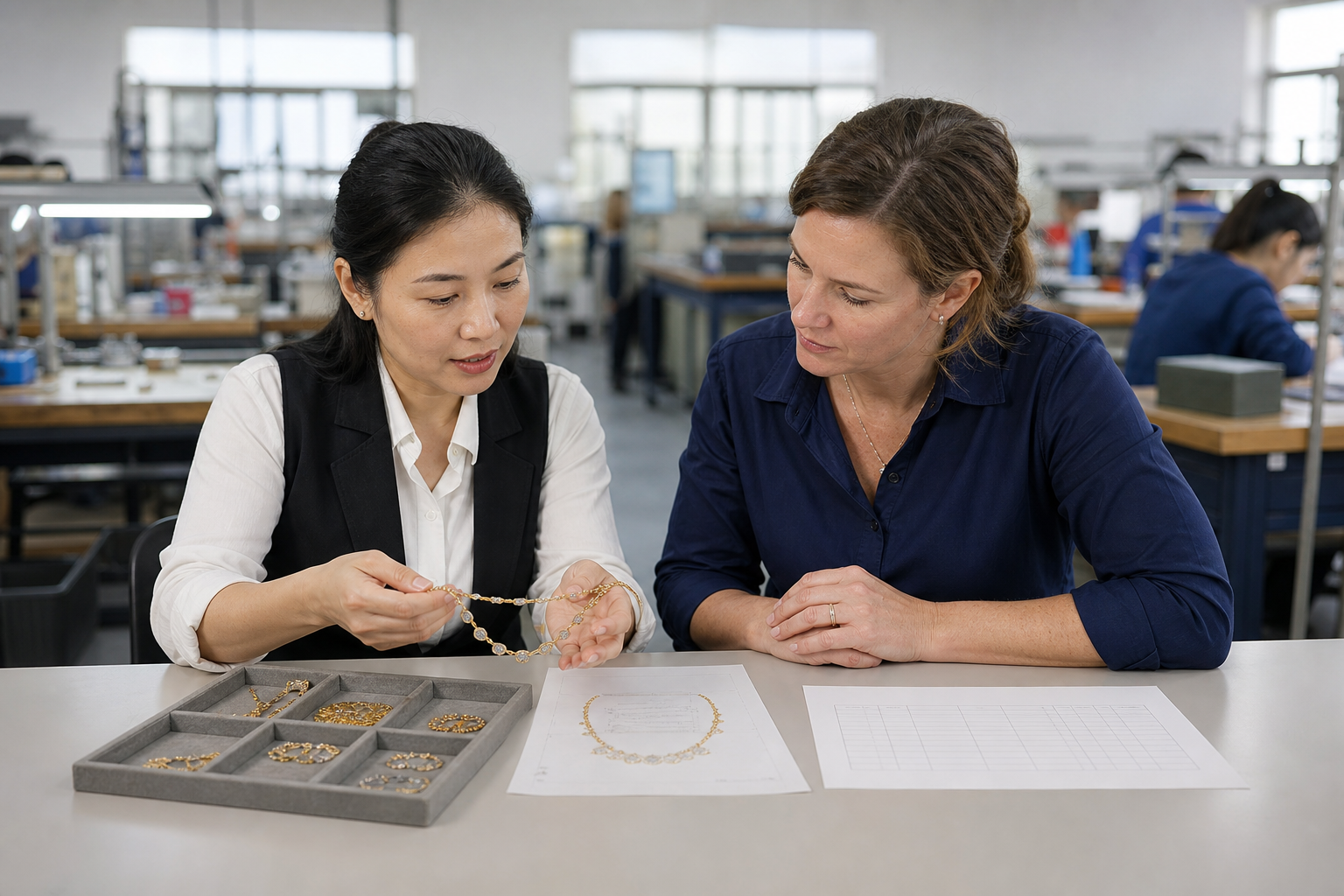
For a private-label brand, the best way to compare jewelry manufacturer quotes is to create one controlled brief, ask every supplier to quote against that same brief, and then identify every assumption that is excluded, provisional, or subject to sample approval. This reduces surprises after sampling and makes a production decision easier to defend internally.
At OWGOW, a standard project starts from 100 pieces. Sample planning is typically about three days after the design direction and materials are confirmed, while standard bulk production is typically 7–10 days after approval. Those timings are planning references, not substitutes for a written project schedule.
What Should a Jewelry Manufacturing Quote Include?
A comparable jewelry manufacturing quote should identify the exact item being quoted and the commercial conditions around it. The best quotations do not hide important assumptions inside a short product name such as “gold necklace” or “custom earrings.” They name the requested configuration in enough detail that a buyer can see what would change the price.
The minimum quote fields
Ask for these fields in writing:
- SKU or working product name, plus a revision date.
- Base material, visible components, stones or pearls, and any buyer-supplied items.
- Finish description, color reference, and whether an approved sample is required before bulk work.
- Dimensions, chain length, clasp type, post or backing type, and weight tolerance where relevant.
- Logo, hallmark, hangtag, card, pouch, box, label, and outer-carton scope.
- Quantity by SKU, color, finish, and size—not only a total order quantity.
- Sampling charge, tooling charge, mold charge, setup charge, and whether any amount can be credited under defined conditions.
- Unit price, currency, payment terms, Incoterm or named handover point, and price-validity period.
- Planned sample and bulk timeline, plus the event that starts each clock.
- Quality-control scope, factory testing discussion, shipment inspection scope, and the buyer’s acceptance criteria.
The [jewelry tech-pack guide](../jewelry-tech-pack-and-design-brief-guide/) explains how to turn product details into a production-ready brief. A quote can only be as clear as the information it receives.
Why the Lowest Unit Price Can Be the Least Comparable Number
One supplier may include a polished stainless-steel clasp while another assumes a lower-cost component. One may include an anti-tarnish pouch and another may quote only a bulk polybag. One may plan an inspection against an approved sample while another has not been given a golden sample. Those differences can be commercially important even when the product photos look similar.
The price itself is not the problem. The problem is an unspecified price. A buyer should treat a very short quotation as an opening estimate and request a scope sheet before using it to select a supplier.
| Quote area | What to compare | Buyer question |
|---|---|---|
| Product build | Base metal, dimensions, components, stones | “Which details are assumed rather than confirmed?” |
| Surface finish | Finish name, color, coverage, protection | “What physical sample will become the approval reference?” |
| Branding | Logo method, location, artwork readiness | “Is artwork setup included, and what file is needed?” |
| Packaging | Unit pack and transport protection | “Does the quoted pack protect this exact product in transit?” |
| Quality | Inspection points and acceptance standard | “What will be checked before shipment, and against which approved reference?” |
| Delivery | Handover point, freight, duties, insurance | “Which costs and risks are included or excluded?” |
For export projects, commercial terms should be written precisely. The International Trade Administration’s export guidance notes that product preparation, negotiation, and compliance planning belong in the export process. For a jewelry order, that means defining the delivery basis before a quote is approved, not after cartons are ready.
Step 1: Freeze the Quote Request Before Asking for Prices
Start with a one-page request that every supplier receives without changes. Add photos or drawings, but do not rely on visual references alone. A useful request states the product application: for example, whether a bracelet is for daily retail wear, a one-season fashion collection, a gift set, or a promotional launch. Intended use influences construction, packaging, care communication, and the level of risk a buyer is willing to accept.
Write the buyer’s non-negotiables
Separate requirements into three groups:
- Fixed requirements — material, key dimensions, visual direction, market, packaging format, and target quantity.
- Options to quote separately — alternative base metals, finish options, stone grades, logo methods, or box upgrades.
- Open questions — items that require a supplier recommendation or physical sample before a decision.
This prevents an unhelpful situation in which each factory silently solves an open question differently. It also makes installation preparation clearer when the product includes displays, earring cards, retail sets, or components that must be assembled before use.
Step 2: Compare Material and Component Assumptions
Material names alone do not tell the full commercial story. A “gold-tone ring” can differ in base material, weight, casting detail, solder joints, stone setting method, finish system, and protective handling. A quote should show enough detail to distinguish a visually similar item from a commercially equivalent item.
Ask suppliers to flag alternatives rather than replacing materials silently. If the requested material is unavailable or unsuitable for the design, a supplier can offer an alternative, but the quote should say what changed and why. This is particularly important for customer requirements involving metal sensitivity, color consistency, repairability, weight, or retail claims.
For products marketed in the United States, the FTC’s Jewelry Guides explain that jewelry marketing claims about factors such as metallic content, treatment, quality, and other attributes should be truthful and non-deceptive. That is not a substitute for legal advice for a specific market or claim; it is a practical reason to align the product build, sales copy, and supporting evidence before launch.
Step 3: Separate Sampling, Tooling, and Bulk Production Costs
A first sample may involve development work that does not repeat in bulk production. New molds, unique findings, custom stone cuts, logo stamps, artwork setup, and special packaging can each have separate cost logic. Ask for each amount separately rather than asking a supplier to hide everything inside a unit price.
Questions that make development costs transparent
- Is the sample price based on the same material and finish intended for bulk production?
- Does the sample include branding and packaging, or only the jewelry item?
- Is new tooling required? If yes, who retains it and under what written terms?
- Which costs are one-time, and which recur with every order?
- Does a later revision require a new sample or a revised quote?
- What is the decision point for moving from an estimate to a production quote?
Factory testing should also be discussed at this stage when it is relevant to the design or market. Do not assume that a generic report covers every future configuration. The specific product, material, test method, sample identity, and customer requirements matter.
Mid-Article CTA: Request a Comparable Quote
If you are comparing suppliers for a new jewelry program, send OWGOW your design direction, target market, estimated quantity, material preference, and packaging needs. We can identify the information needed for a practical quote before sampling begins. [Send your requirements](../../index.html#contact) or email [info@owgow.com](mailto:info@owgow.com).
Step 4: Compare Packaging and Shipment Readiness
Packaging is not merely a branding add-on. It controls how the product is presented, protected, counted, labeled, and handed over. A lower unit price can become less useful if the buyer later adds pouches, cards, anti-tarnish protection, master cartons, labels, or damage-prevention inserts that were not included.
For every quote, compare the unit pack and the shipment pack separately. The [private-label packaging guide](../custom-jewelry-packaging-guide-for-private-label-brands/) gives a more detailed checklist for cards, boxes, pouches, labels, and outer cartons.
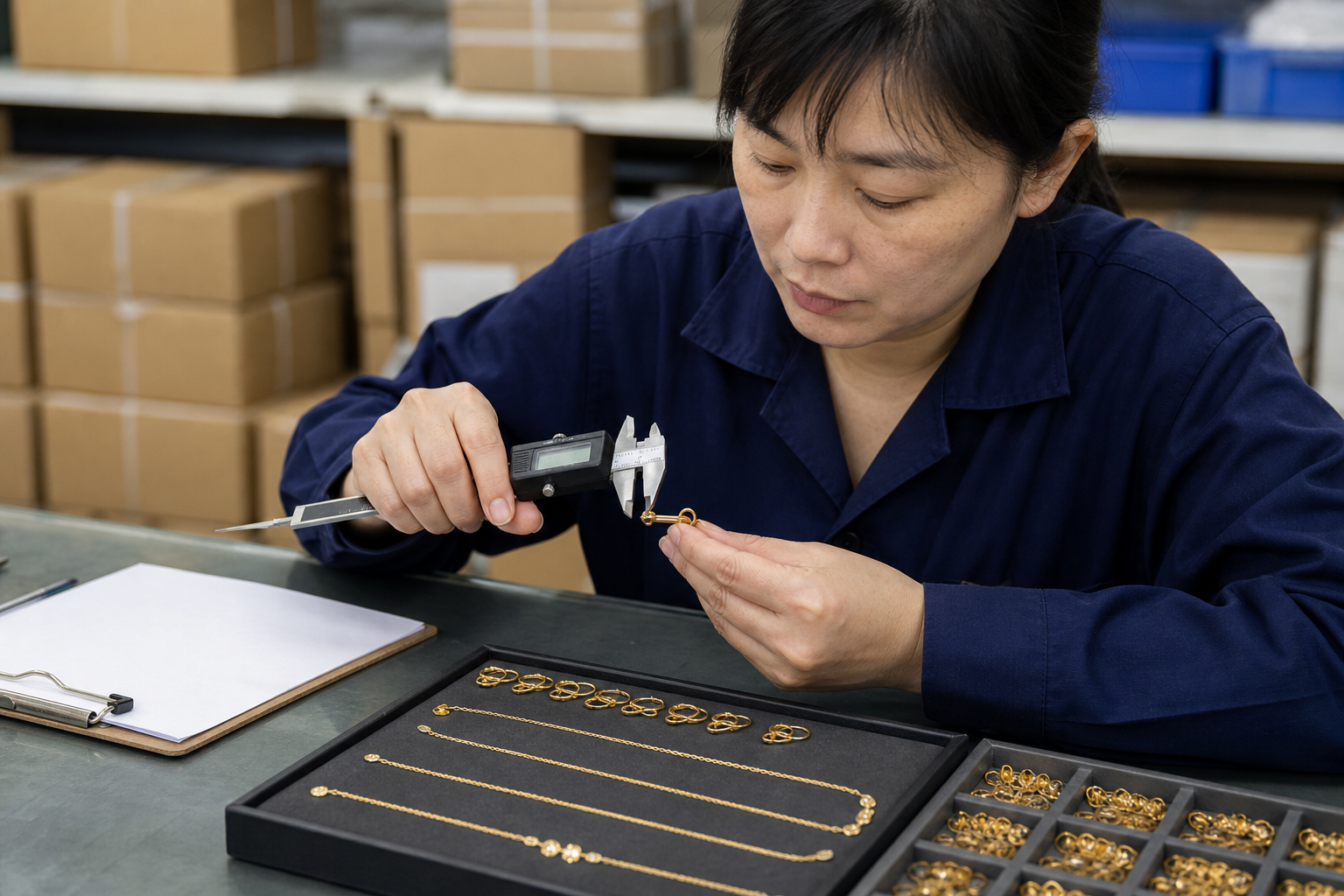
Before dispatch, shipment inspection should connect the approved sample to the finished item, branding, packaging, quantity, labels, and cartons. The buyer should state what evidence is needed: photos, count records, inspection notes, packing list confirmation, or a third-party inspection arrangement. A supplier cannot reliably inspect against a standard that has not been agreed.
Step 5: Confirm Timing Without Treating It as a Guarantee
Lead time should be read as a sequence of gates, not a single number. A sensible schedule shows when the supplier receives complete artwork, when a sample is reviewed, when the golden sample is approved, when materials are reserved, when bulk work begins, when the shipment inspection is completed, and when goods are handed to the carrier.
At OWGOW, sample planning is typically around three days after the design direction and materials are confirmed. Standard bulk production is typically 7–10 days after scope approval. Complex construction, new tooling, special components, packaging, revision rounds, supplier capacity, public holidays, and shipping bookings can change a project schedule. Buyers should request a confirmed timeline for the actual order.
A Practical Quote Comparison Scorecard
Use a simple scorecard after the quote scope is complete. Avoid scoring only price.
| Decision factor | Evidence to collect | Why it matters |
|---|---|---|
| Scope clarity | Dated specification and exclusions list | Reduces later change orders |
| Sample control | Approval path and retained reference | Connects development to bulk production |
| Material transparency | Named base metal, components, and alternatives | Supports consistent product decisions |
| Quality process | Inspection points and acceptance criteria | Makes shipment inspection actionable |
| Packaging fit | Unit and transit protection plan | Protects product application and brand presentation |
| Commercial terms | Currency, payment, handover point, validity | Avoids false price comparisons |
| Communication quality | Questions raised before quoting | Signals whether ambiguity is being managed |
The best supplier is not necessarily the supplier with the longest document. A strong quotation is one that makes assumptions visible, asks useful questions early, and can be checked against the approved sample and purchase order later.
FAQ
Should I ask several jewelry manufacturers for the same quote?
Yes, provided every supplier receives the same controlled brief and the comparison records what is included, excluded, or provisional. Different factories may identify different production risks; those questions can be valuable evidence, not simply an inconvenience.
What is a realistic MOQ to quote for a private-label project?
MOQ depends on the SKU, material, finish, components, branding, packaging, and number of variants. OWGOW’s standard MOQ is 100 pieces, subject to confirmation for the specific project configuration.
Can I compare quotes before approving a sample?
Yes. Early quotes help assess feasibility and budget, but they should be labeled as estimates where the product build or finish has not been confirmed. Treat the approved sample and final specification as the point at which a production quote becomes more reliable.
Does a quoted unit price include freight and import costs?
Not necessarily. Ask for the named delivery point, the agreed Incoterm, and a line-by-line statement of freight, insurance, duties, taxes, and destination charges. See the [Incoterms guide for jewelry importers](../incoterms-for-jewelry-importers-exw-fca-fob-guide/) for the questions to settle with a freight professional.
What is the most important question to ask about a low quote?
Ask: “What is not included, assumed, or still subject to sample approval?” Then request the answer against a dated SKU-level specification. This often reveals the difference between an attractive estimate and a comparable production offer.
Conclusion
Comparing jewelry manufacturer quotes is a specification-control exercise before it is a price exercise. Fix the brief, expose the assumptions, separate one-time and recurring costs, confirm the sample and inspection path, and write the delivery basis clearly. Doing this work before an order is placed protects both buyer and supplier from avoidable changes later.
CTA: Get a Quote You Can Compare
Planning a private-label jewelry launch with a 100-piece MOQ? Send OWGOW your product brief, application, target market, estimated quantity, and packaging direction. We will respond with the information needed to move toward a quote-ready scope. [Get a quote](../../index.html#contact) or email [info@owgow.com](mailto:info@owgow.com).