Introduction
Jewelry buyers often discuss “shipping included” before they have agreed where delivery happens, who appoints the carrier, who handles export steps, and when risk changes hands. Incoterms® rules provide a common language for allocating defined delivery, cost, and risk responsibilities in B2B sales contracts. They do not replace the sales contract, freight booking, insurance, product acceptance, or customs advice.
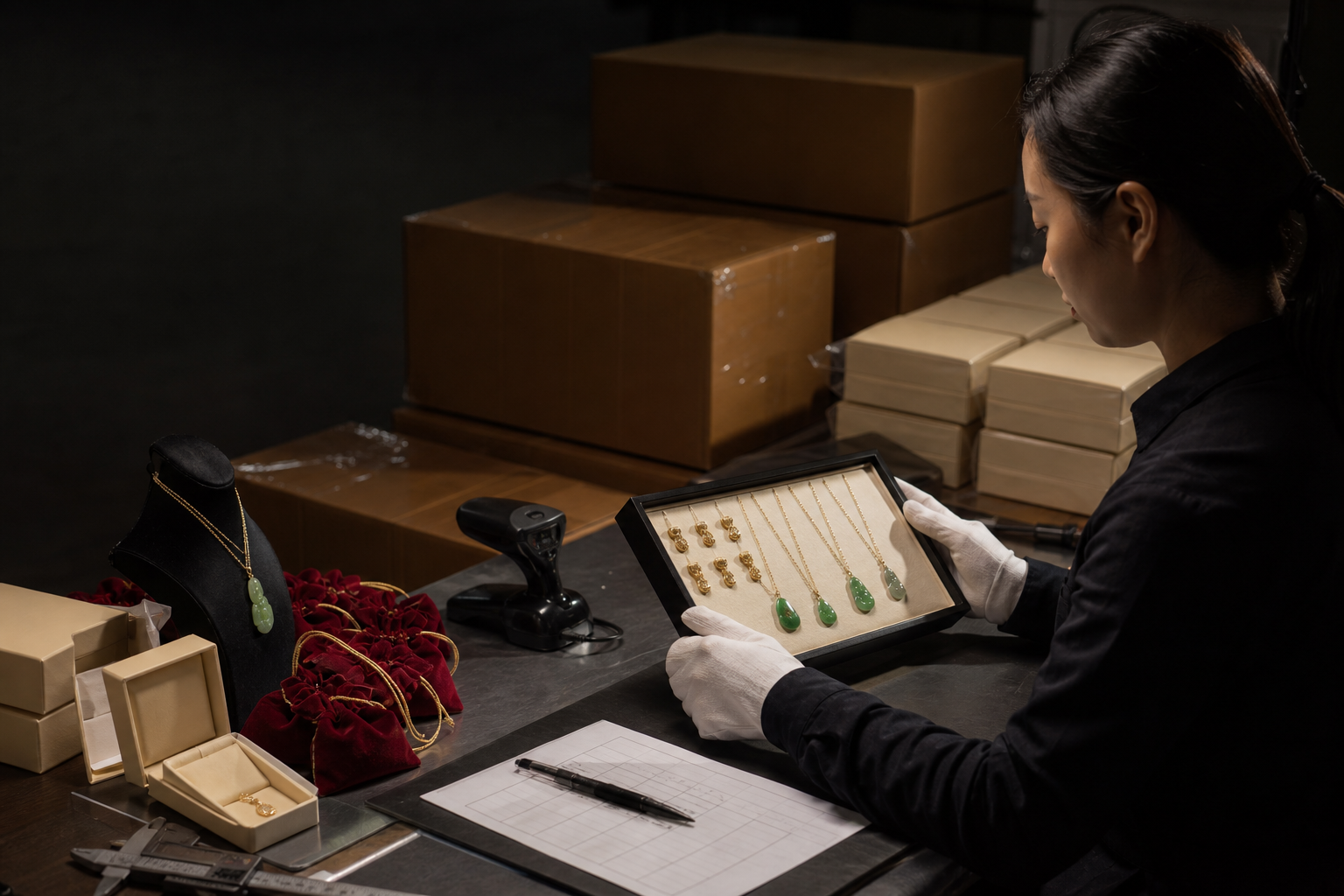
For an importer buying jewelry from China, three terms commonly appear in early discussions: EXW, FCA, and FOB. The correct option depends on the transport mode, collection point, export capability, forwarder, and contract. This guide explains the questions a buyer should settle before cartons leave the factory.
The short answer: write the rule and named place clearly
Use the agreed Incoterms® rule together with its version and named place or port, then align the quotation, packing instructions, shipping booking, and documents to that agreement. “FOB China” is not a complete instruction; the parties need a named port and a shared understanding of the chosen rule.
The ICC’s Incoterms® 2020 resources explain that the rules allocate important buyer and seller responsibilities for transport and delivery. For the official detail, consult the ICC publication and qualified freight or legal advisers.
EXW: collection at the seller’s premises
EXW, or Ex Works, is often understood as collection from the factory or another named place. In practice, buyers should be precise about loading, collection time, export clearance, documents, and which party has access to the relevant logistics process. It may look simple but can leave operational questions unresolved when an overseas buyer appoints a forwarder.
Before using EXW, confirm the collection address, handover time, carton dimensions and weights, loading arrangements, packing list, commercial invoice, and any export-document responsibilities. Your freight provider should confirm whether the route and export setup are workable.
FCA: handover to the buyer’s carrier
FCA, Free Carrier, can be useful when goods are handed over to a carrier at a named place. It is applicable to different transport modes, but the exact named place matters. Is handover at the seller’s premises or at a terminal? Who loads? Who handles export clearance? These questions should be written into the order and booking instructions.
For containerized or multimodal shipments, buyers should not automatically substitute FOB. The ICC’s FOB guidance explains that FOB is for sea or inland-waterway transport and that FCA may be more suitable when goods are handed to a carrier before being placed on board a vessel. Read the current ICC FOB explanatory note with your forwarder before choosing a term.
FOB: delivery on board at the named port
FOB, Free On Board, is a sea or inland-waterway rule. It should state the named port of shipment. Under the rule, the delivery and risk point is linked to the goods being on board the buyer-nominated vessel at that port, as described by the ICC. It is not simply a generic phrase for any export shipment.
If your jewelry order will move by courier, airfreight, rail, road, or a containerized multimodal route, obtain freight guidance rather than copying an FOB term from a previous order. The route can change the appropriate handover and documentary arrangements.
Connect the term to product controls
The delivery term does not decide whether the order matches the approved sample. Do not let shipping urgency replace factory testing and shipment inspection. Before handover, review finished quantity, SKU mix, visible finish, functional parts, branding, packaging, carton markings, invoice, packing list, and collection instructions. The product reference should match the approved sample and customer requirements.
Installation preparation is also relevant: confirm how finished jewelry sits in its final packaging, how outer cartons are divided, and how fragile items are marked or protected. Once the agreed handover point is reached, a buyer has less opportunity to correct a missing card, mixed SKU, or unprotected necklace.
Questions to put in the purchase order
- Which Incoterms® rule, version, and named place or port apply?
- Who appoints the carrier and supplies shipping marks?
- What are the planned collection and cargo-ready dates?
- Which documents are required and in what format?
- When is inspection complete and what happens if a discrepancy is found?
- Who arranges cargo insurance, and what does it cover?
- How will carton count, weights, dimensions, and SKU mix be confirmed?
Incoterms® rules do not set price, payment date, transfer of title, intellectual-property rights, product warranty, or dispute resolution. Address those items separately in a commercial agreement.

FAQ
Which term is best for a new jewelry importer?
There is no universal best term. Choose based on transport, forwarder capability, customs responsibilities, insurance, and the named handover point. Obtain professional advice for the actual shipment.
Does FOB include insurance?
Do not assume it does. Insurance arrangements should be stated separately and checked with the insurer or freight provider.
When should shipment inspection happen?
Complete the agreed inspection before the planned handover or collection, allowing time for correction if the order does not match the approved specification.
Conclusion
Use Incoterms® as a precise handover framework, not as a loose shipping label. State the rule, version, and named place; align documents and collection instructions; and complete product checks before the delivery point. That gives buyers a more controlled transition from factory to freight.
CTA
[Send Your Requirements](mailto:info@owgow.com) for an export-ready product and packing brief. For final order checks, read our pre-shipment inspection guide.